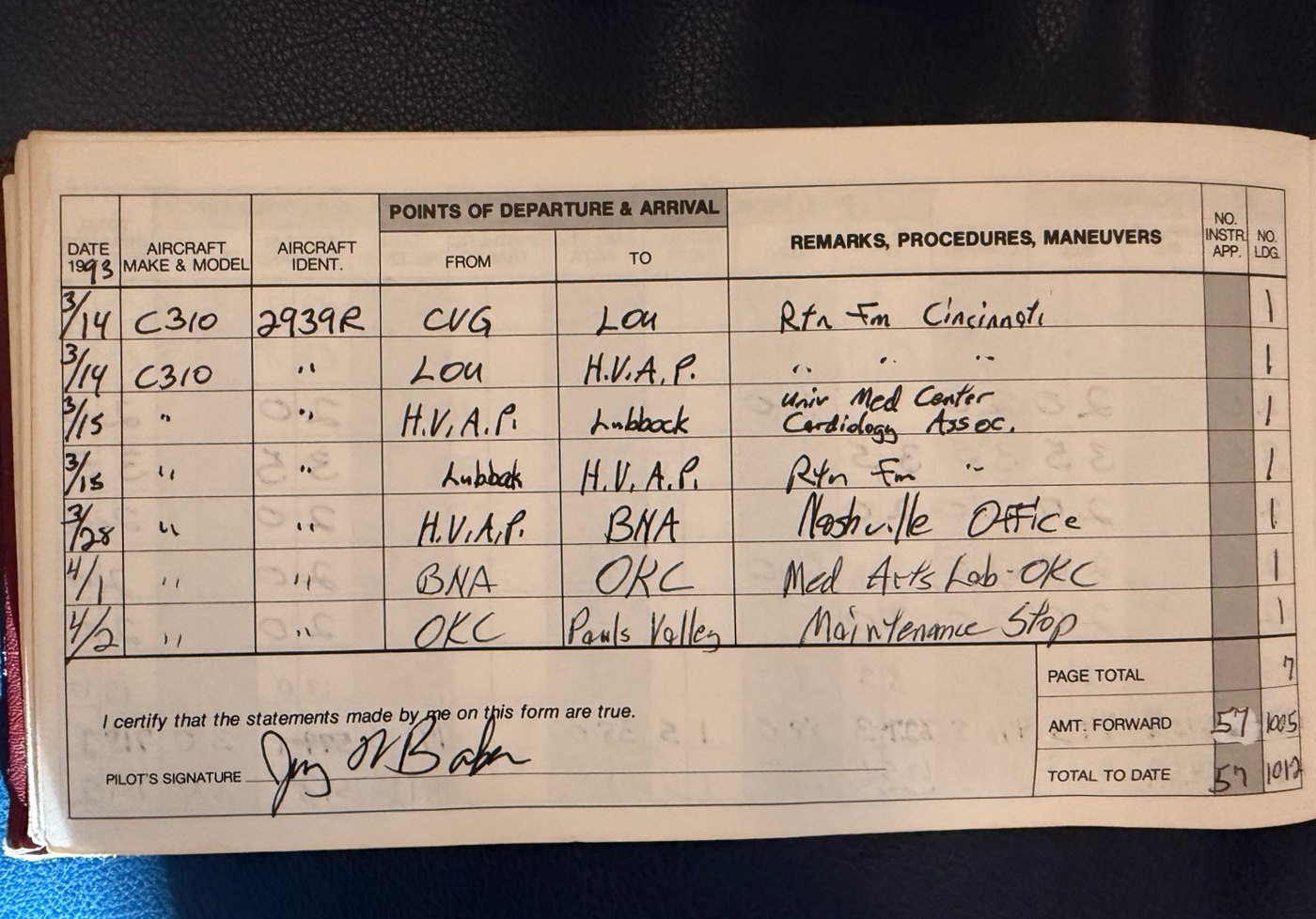
The logbook says one landing. There were two. I never wrote down the first one, in Memphis. I think I wanted to pretend it had not happened. It did.
It was the first of April, 1993, April Fools’ Day, and I was flying my Cessna 310 from Nashville to Oklahoma City. Hospital financial officers from all over the state would be there for a meeting of their trade association, the Healthcare Financial Management Association, and so would a client, Med Arts Lab, whose name I wrote in the remarks column the way I always did, for the tax man. I had meant to leave in the late afternoon. For reasons I can no longer remember, I did not reach the airport until the sun was nearly down.
I called Flight Service from the FBO for a weather briefing. It was the strangest briefing I ever received. A low overcast had settled over Nashville. A briefer’s job, most days, is to give you all the reasons not to go. This one told me to hurry. It was still daylight, he said. If I took off now and followed Interstate 40 west, I would be out from under the overcast before long, and from there it was clear all the way to Oklahoma City. He had a friend who did it all the time.
I remember standing there with the phone in my hand, puzzled at the words coming through the receiver. I should have listened to the puzzlement. But I needed to make this business trip, and if the briefer said it, it must be all right. Pilots trust a weather briefer the way patients trust a doctor.
By the time I walked out to the airplane the sun was low. The fuel truck was slower than usual, or seemed to be. I preflighted, and took off just before sunset, and before I had even left the airport traffic area and said goodbye to the tower, the ceiling was pressing me down at a thousand feet above the ground. Nashville has towers, power lines, and hills that rise and fall without warning. It was white-knuckle already.
I should say what I had decided before I ever left the ground. I held an instrument rating, but I was not current. My 310 had no autopilot, and in real clouds, at night, a pilot without one is a man doing three jobs with two hands. And this bird had no de-icing equipment at all. If there was ice in those clouds, she could not shed it. So I would not climb into them. I would stay underneath, no matter what.
I knew I-40. I had driven it many times, coast to coast and back with the Marines in 1985, and on one of those trips, east of Knoxville, an ice storm had come down so suddenly that trucks jackknifed and cars spun into each other all around me, and I came through it by the grace of God. That night I followed the same road west, a thousand feet above two black ribbons, with the last of the sun ahead of me.
A curve that seems long and gentle in a car at sixty-five is a different thing in an airplane at a hundred and eighty miles an hour. After a few of them had me in a sixty-degree bank just to stay with the road, I slowed down, way down, to about a hundred and twenty. The curves became manageable. The margin I would need if I ever had to climb became smaller.
Within twenty minutes three things had happened. The sun went down. The cars and trucks below turned on their headlights. And the overcast began to come lower.
It was thick and dark, and it let no moonlight and no starlight through. The only light in the world came from the traffic beneath me, and the cloud pressed me down toward it, lower, and lower. The curves were tighter now, and the hills on either side of the highway were higher. I was in a pincer. I had promised myself I would not climb into that cloud, and the cloud was not making any promises at all.
I cursed the briefer. I cursed myself more, for listening to him, for not trusting the instinct that had told me, standing there with the phone in my hand, that no briefer should ever say what he had said. Something had not been right, and I had known it, and I had gone anyway.
I reached up and turned off every light in the cockpit. The instrument lights, the panel lights, all of them, until it was pitch black inside the airplane. I did not need the gauges. I needed my eyes. They were fixed, every bit of them, on the road ahead and on the dark shapes of the hills sliding past on either side. With each overpass, I would nudge her up ten or twenty feet, just to be sure I cleared them, then press back down as low as I could bear it.
Then a blinding white light came from my own wings.
I had never seen anything like it, and I never have since. On a straight stretch of highway I had squared off in front of a semi-truck, and its bright headlights were blazing off the leading edges of my wings. I was forty feet or so above the ground, flying at a hundred and twenty miles an hour, with a truck driver looking up at me through his windshield.
I do not know how long that lasted. Not long. Long enough.
And then, somewhere west of Nashville, by the grace of God and, I have no doubt, the prayers of my mother, the clouds were simply gone.
In Saint-Exupéry’s Night Flight, there is a pilot named Fabien, lost at night in a storm over Patagonia, who sees a few stars through a rift in the clouds and climbs toward them, and comes out above the storm into a sky so bright and still it is almost holy. It is the most beautiful thing he has ever seen. It is also a trap: he is above the clouds with his fuel running out, and he will never come down through them alive. Fabien climbed to the stars and was lost. I stayed beneath the clouds, and the stars came down to me.
The sky opened into the most gorgeous star-filled night I had ever seen. I pushed the props and throttles forward and climbed, gently, up into it. It took a while for my breathing to come back.
I did not need fuel. I needed the ground under my feet. Memphis was dead ahead. I called Approach, was handed to the tower, and landed, and the tires made that squeak-squeak as I touched down that is always satisfying, and never more than it was that night. Inside the FBO there was no one that I remember. I sat down in one of those recliners that every FBO keeps for tired or bored pilots, and for the first time I realized my legs were shaking. Not trembling. Shaking, uncontrollably. I decided to sit until they stopped. They did, eventually.
I had a cup of coffee I probably should not have had, and took off again into that sky full of stars, and flew the rest of the way to Oklahoma City against a stiff headwind, as peacefully as I have ever flown anywhere. At the hotel I looked forward to seeing friends and clients in the morning. Then, I slept.
In the morning there was a voicemail from my boss, Larry, asking if I was okay. I thought it was kind of him, and a little odd. Why would I not be okay? He could not have known what I had flown through the night before. When I called him back he was relieved, and puzzled. “Jerry,” he said, “you didn’t hear about the crash last night?”
A twin had gone down in Tennessee in the clouds and ice, and a NASCAR driver was aboard.
It was Alan Kulwicki, the reigning champion of the sport, on his way to the race at Bristol after an appearance in Knoxville. With him were two executives of the company that sponsored his car, Mark Brooks and Dan Duncan, and their pilot, Charlie Campbell. Their airplane left Knoxville a little before nine that evening, Eastern time. Half an hour later, descending through the clouds toward the Tri-Cities airport, both engines quit. The investigators found that ice had been swallowed into the engines. The airplane had the equipment to keep it out. It had apparently not been used as it should have been. All four men perished in a meadow a few miles short of the runway.
Larry had heard it was a 310, out of Nashville. It was not. It was a different airplane, from a different city on the other side of the state. But it was the same night, in the same kind of weather, over Tennessee, and the clocks line up. Knoxville keeps Eastern time; Nashville and Memphis keep Central. Their airplane left Knoxville, the city where an ice storm had nearly caught me on the highway eight years before, at about eight o’clock my time. At about half past eight they went down — while I was still sitting in that FBO recliner in Memphis, waiting for my legs to stop shaking.
That is not the end of it. Even writing this, I very nearly left the rest out.
The next time I went back to Nashville, I drove. Just west of the city, on I-40, I looked up through the windshield and I saw something that horrified me. I had never noticed it in all the times I had driven that road. A high-tension power line, strung from tower to tower straight across the interstate. It was high, higher than most power lines. But not so high that a man flying at forty feet or so could count on passing beneath it.
I had flown under it.
In the dark, beneath the cloud, following the headlights, I had passed under those wires at a hundred and twenty miles an hour without ever knowing they were there. I never saw them. At night, against a black sky, no one could have. That overcast had pressed me down, lower and lower, toward the road, and I had hated every foot of it. If it had let me fly a little higher, the way I wanted, I could have flown straight into them.
I have never understood why one man is spared and another is not. I do not think we are meant to. I know only that I made one good decision that night, which was to stay out of the clouds, and a string of bad ones that put me in a place where one good decision had to carry everything. And I know that the one good decision was not enough. The cloud that pressed me down was the thing that kept me under the wires. Their pilot had the equipment I did not have, and the clouds took them anyway. I had nothing but a promise to myself, a highway full of headlights, and my mother praying somewhere in Oklahoma.
God works in strange and mysterious ways. I am thankful to be alive. And every April Fools’ Day, I think of four men who never landed, and I am sorry. May God rest their souls.
The logbook still says one landing. I have decided to leave it that way. Some entries are kept in other books.